
Auteuritis
More on words and films, from Crowther to Barthes

My previous article here, How to claim things with words, was about words. Unclear words, misleading words, meaningless words, irrelevant words, and how we create our past and our context by the words we use to describe it, often in conflict with the past as it was and the context as it is.
One word I did not mention then was “auteur,” so let me do that now.
Despite its prevalence, there is remarkably little agreement about what exactly the word “auteur” means, who is one, and why or why not. Instead, auteurism is unnecessary and often unhelpful. It ignores the first fifty years of writing about films, adds nothing that is genuinely new, defers too readily to a handful of chosen authorities, and, more often than not, makes things needlessly confusing. I shall explain why, but first, just look at this absurd word salad, from a new book about Michael Mann.
Is Michael Mann an auteur? Mann is a formidable filmmaking personality, no doubt, but the notion that today’s celebrity cult of the director immediately correlates with the mysterious sect of ‘auteur’ is questionable and deserves to be investigated.1
As for the first question, there are only two possible answers. “Yes, according to any reasonable definition of the term.” or “No, because there are no such things as auteurs.” But what is “today’s celebrity cult of the director”? What is different “today”? When did “today” begin? Is there a cult around Mann? What is this “mysterious sect”? Who are its members? Are you one of them?
Another recent book, about the cinematographer Gregg Toland, is some 300 pages long. The first 70 pages tell the tale about “auteur theory” and the many discussions about it. All the usual subjects are quoted. You get this a lot, these lengthy summaries, although usually in books about directors. It is incomprehensible to me why people do this. Auteurism is one of the most well-known ideas in film studies, nobody needs to read those pages which never add anything you cannot find in your average Wikipedia-entry. The other reason why it is incomprehensible is that it has little to do with how films are made, how they have been perceived, and how directors have been discussed before 1954.2
I say 1954 because it is almost always claimed that this is when it began. The reason is Truffaut’s famous article “A Certain Tendency in French Cinema” from January of that year. But it is not arguing what people seem to think it does and it is not saying anything new. Truffaut was mainly attacking the scriptwriting duo Jean Aurenche and Pierre Bost, and focussing on four main things: that films can be more faithful to the books they are based on, that Aurenche and Bost’s anti-clericalism was hypocritical, that, ideally, scripts should be written by the directors, and that one strain of French cinema, called “the tradition of quality,” (he never mentions American films) was inferior to the French films and filmmakers he preferred, those for which “it so happens — by a curious coincidence — that they are auteurs who often write their own dialogue and in some cases think up the stories they direct.”3 None of this was groundbreaking, or some paradigm shift.
If you absolutely must claim that “auteur theory” began in postwar France, then Bazin’s report from the Cannes film festival in 1946 makes more sense. There he says that American directors can now be considered as equivalent to American novelists,4 a more interesting argument than Truffaut’s later complaints.
But how do you think films and directors were perceived before the war? Much in the same way, and the directors that were celebrated then were often the same directors that the French critics of the 1950s would also celebrate. You can easily find articles and books from the 1920s, 1930s, and 1940s, in various languages, extolling the strengths and virtues of Hitchcock, Ford, Lubitsch, Lang, von Stroheim, von Sternberg, Preminger. But also directors like Tay Garnett, Woody Van Dyke, Rouben Mamoulian, George Stevens, William Wyler, and Mervyn LeRoy. It is not at all clear what was new with the 1950s critics at Cahiers du Cinéma.
The leading British film critic Dilys Powell asked, in a talk in 1946, “How can one man leave the mark of his personality and his talent on this hugger-mugger?” and she answered, “But he does.”5 When Powell said that she was not being a “proto-auteurist” or whatever, she was just stating a conventional wisdom among critics, long before 1954.
In 1939, Bosley Crowther reported in the New York Times that a debate was going on in the film community about whom should be considered the author of a film, was it the director, the writer, the producer, or perhaps even actors? Crowther himself seemed to be undecided, but it seemed the director was getting the upper hand. To regard the director as the centre piece of the filmmaking process, as the artist behind the film, despite its complicated, collaborative nature, was often the default position. Adding the term “auteur” to the conversation did not do anyone any favours, except maybe Howard Hawks’s reputation in the US.
People like to quote Eugene Archer’s letter to Andrew Sarris, after Archer had encountered some French critics in the 1950s.6 In the letter he famously asked Sarris, “Who the hell is Howard Hawks?” But this only proves, at best, that Archer was puzzled by why they loved Hawks. This was not new either, French critics had loved Hawks at least since A Girl in Every Port (1928).
This, in a roundabout way, brings us to Sarris. He matters primarily for two things: he coined the term “auteur theory” and he wrote the immensely influential book The American Cinema in 1968. That term is unfortunate because “auteur theory” is not a theory, and Sarris did not think it was. He almost immediately retracted it in a later paragraph. It would have been better if he had never used it, as it has misled both his fans and his foes. The impact of his book has also been a problem; its influence out of proportion to what he had to say. As with the obsession with the Cahiers crowd, there is an unproductive obsession with him for far too many who are writing about directors. Let me use Fred Zinnemann as an example.
It is almost impossible to find anything written about Zinnemann (whether a book or an article) in which the writer does not bring up Sarris, either to attack him for being allegedly rude and unfair to Zinnemann, or for some variation of "we need to acknowledge that Sarris pointed out some deep flaws in Zinnemann's direction."
What is it with this fixation? Why do they care so much about what Sarris said in that paragraph in The American Cinema? There is no reason to be hung up on that, it is like an affectation. What Sarris wrote is too short and vague to be relevant, and not something you need to be upset or concerned about today. There is no need to feel sorry for poor Zinnemann or be defensive either.
Sarris was neither right nor wrong about Zinnemann, he just made some brief comments that are obviously not the only relevant benchmark for Zinnemann Studies, as they often seem to be taken as.
It is true that Sarris's entry on Zinnemann contains one of my favourite lines from him: "In cinema, as in all art, only those who risk the ridiculous have a real shot at the sublime." We can debate whether Zinnemann risked that or not (I argue yes, he did7), but it is not the case that all those Sarris liked did risk it, or that all those he disliked did not, so it is not a good yardstick for evaluating someone's career, or Sarris's views of them.
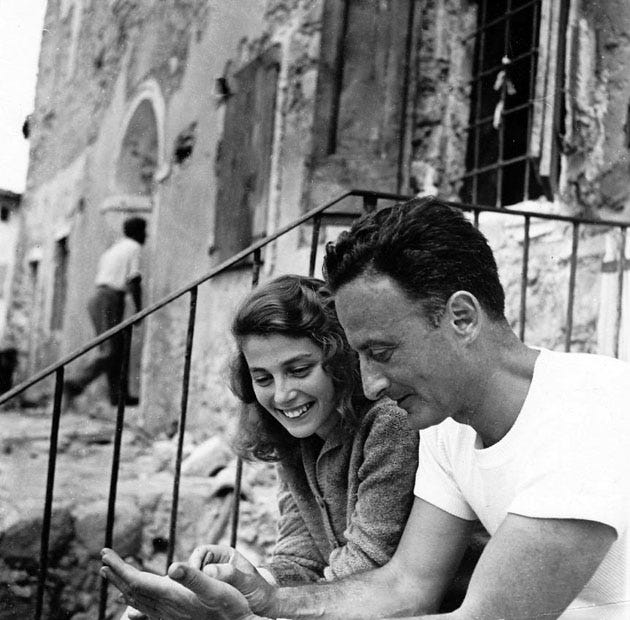
There is something similar going on with how everyone writing a book about a filmmaker feel obligated to bring up Barthes's "the death of the author," as if that was an elevated truth, or the sum total of all Barthes has said on the topic. In his article, first published in late 1967 in the magazine Aspen, Barthes argued that it is the reader of a book, not the author of the book, that creates the meaning we get from reading it. I do not think this is relevant for any discussion about how much personal agency directors have when making a film. Barthes is talking about something else.
There is no reason to treat his article as anything more than a repeat of a popular belief that you should not be beholden to the author’s intentions when reading or evaluating a book, or any artwork. I think we should consider intentions too, it is not a fallacy by default to do so, but regardless of that, Barthes is writing about interpreting a finished work. He is not writing about how the work was created. In addition, Barthes has also written about this from other angles, which are in conflict with the “death of the author”-idea, such as his distinction between a readerly and a writerly text. That is a more useful way of assessing a film, a director, or a body of work, if scholars cared about using Barthes for his thinking and not just as a goalpost.8 What matters here is not Barthes himself, but the persistent reflex to invoke him as an unquestioned authority.
Now let me turn to another new book, the first academic one about Mervyn LeRoy, for another common example of persisting fixations and confusions.9 The introduction of the book, written by Murray Pomerance and R. Barton Palmer, consists almost entirely of petty complaints and snipes at Andrew Sarris. As part of their anti-Sarris affectation, they also feel compelled to "emphasize that we do not mean to suggest that LeRoy is an underappreciated auteur."
Let me pause here and consider this common thing where film scholars say, “Please read my book but first let me disavow its main thesis.” What is that about?
Their statement is contradicted by the rest of the book, the purpose of which is obviously to suggest that LeRoy is an underappreciated auteur. The chapters do this in all kinds of ways, almost always emphasizing LeRoy's "core qualities," his style, his politics, and even drawing connections between his work and his childhood. If you are not yet convinced that the line is dubious, let me quote the last sentence in the book: "From this angle, reaching back to I Am a Fugitive and forward to Moment to Moment, LeRoy, auteur of the first magnitude, brings to his cinema a strong commitment to social consciousness in diverse settings and conditions, even the idealized time, space, and sunshine of his last feature."10 (My emphasis.)
Which is fine. “Mervyn LeRoy is a talentless hack of no importance and we want to do a book about him.” is not much of a pitch, and LeRoy has certainly made enough great films to warrant this book, but the disconnect between the introduction and the rest is dizzying.
But which director is not an auteur? Who are these "journeymen," the directors standing as the auteurs’ alleged antithesis? Who is qualified enough to assess whether, say, Frank Lloyd is a journeyman or an auteur, and why would it matter?11 On what basis is this decided? Those who are called “journeymen” are by default directors nobody has researched or analysed. If we must use the term auteur, it would be more accurate to divide directors into the two groups of “auteurs” and “subject for further research.”
Jacques Rivette once said that for him what mattered was if the director was also involved in the scriptwriting. Therefore, he claimed, Wyler and Zinnemann were disqualified. He was wrong there, as they were deeply involved in the scripts of their films, but which director is not? And presumably you would have to know this before being able to say whether you approved of a director or not, and is that not weird?
As you may have gathered, I do not think auteur is a term that has been useful; it is just a stick to beat your opponents with, or a statement of personal taste. "I like these directors, therefore they are auteurs. Those guys over there I do not like and therefore they are not auteurs." It is the Euthyphro dilemma of cinema, are they good because they are auteurs, or are they auteurs because they are good.12
If you look at a bunch of films made by a certain director, you will notice that they have things in common, in style, themes, concerns, beliefs, tone, which actors appear and how they perform. This is true for most directors, whether they are called Henry Hathaway, Agnes Varda, Yasujiro Ozu, Nora Ephron, Val Guest, Marc Lawrence, Pedro Almodóvar.13 None of this is naive, or ignorant, or a fallacy, or a capitalist conspiracy. It is an inevitability as films are made by humans.
If you look at films from another director, the same combination of these things will not be there. Their films will have other things in common. What the critic or scholar can do is to figure out what these things in common are. We should also discuss the directors in relation to the scriptwriters, to the cinematographers, to actors, to the editors, to the set designers, and those other key members of the filmmaking team.
These relationships differ substantially as there is no general law at work here. Some films have many writers, with different levels of engagement, others have only one writer who conceived it all. Sometimes that writer is also the director. Sometimes the writer is also the producer, like Nunnally Johnson. Some producers are deeply involved in each aspect of the filmmaking process, like David O. Selznick or Hal B. Wallis. Others prefer to leave the production alone, and see their responsibility as to shield the cast and crew from the outside world, including sponsors or studios. Jerry Wald and Henry Blanke seem to have been examples of this.14 Some cinematographers have a distinct recognisable style, others have not. Sometimes cinematographers are responsible for the look of a film, rather than the director. Other times, and more common, the opposite is true.
Film analysis is hard work, it is a question of watching the films, if possible reading the production files, and the interviews, and searching for those connections. For this we do not need the term auteur, and neither the surrounding theories; the work is already bumpy enough so fasten your seatbelts.
The Films of Michael Mann - From the Prison Wall to the Firewall, by Deryck Swan (Liverpool University Press 2023).
The book, Authorship and Aesthetics in the Cinematography of Gregg Toland (Lexington Books 2022) by Philip Cowan, has the advantage of quoting some cinematographers in this long overview. And I am not necessarily criticising Cowan, the book is based on his PhD thesis, and this kind of overview is almost mandatory when doing a PhD. Alas, his case study of Toland does not begin until page 163, when the book finally becomes somewhat interesting. As Toland is almost the only cinematographer of that era who is known, and famous for his style (John Alton is another), the book would be more forceful and relevant if it had been about, say, Sol Polito, and using his work with Michael Curtiz as a case study.
Available to read here: https://www.newwavefilm.com/about/a-certain-tendency-of-french-cinema-truffaut.shtml
Bazin’s article was published in Le courrier de l’étudiant, October 30 - November 13, 1946.
I wrote about Dilys Powell, a favourite critic, a few years ago: Fredrik on Film: Dilys Powell
Archer had gone to Paris on a Fulbright scholarship to write a book about six American directors, just not about Hawks.
About the sublime in Zinnemann’s work, it is definitely in Five Days One Summer (1982), a film that Sarris liked a lot, and I think also in, for example, The Nun’s Story (1958) and even The Day of the Jackal (1973). Although, it does of course depend entirely on whether my definition of “sublime” is the same as Sarris’s. I think the watermelon sequence in The Day of the Jackal is an example.
Regarding the dead author, if the only thing that matters is each individual interpretation, and the text itself is done without intentions, we cannot make any claims on it, or criticise it. We cannot say a book or film is racist or sexist for example, because it is nothing in itself, only what we project onto it. If Barthes’s view is to be believed, it would also mean that it does not matter if a book was written by a human or an AI. I do not think the same people who nod approvingly to “the death of the author” are the same people who think it is irrelevant whether something is written by AI or not.
Mervyn LeRoy Comes to Town, eds. Murray Pomerance and R. Barton Palmer, (Rutgers University Press 2025)
The last chapter, “Minute to Minute, Moment to Moment” is written by Tom Conley.
Frank Lloyd was a big deal in the 1920s and early 1930s, directing and producing several highly regarded films. Mutiny on the Bounty (1935) is the most (or only) famous one today I imagine.
A reference to Plato’s dialogue Euthyphro, where they discuss this issue with regard to God. Is something good because God wills it, or does God will it because it is good?
An amusing example of this: in the mid-40s, Darryl F. Zanuck, the boss of Twentieth Century-Fox demanded that Hathaway directed a musical called Nob Hill. It was hot property, but Zanuck had failed to get someone to do it. Hathaway demurred, musicals were not for him, yet Zanuck insisted. Hathaway said OK after some discussions. When making it, Hathaway removed almost all musical parts, toughened it up, and rewrote the last part, making the film more in line with his own sensibilities than with the traditional Fox musical.
These examples of producers are from Hollywood because I am more knowledgeable about the details there. The situation with various producers acting differently is the same in other countries too of course.
Sure, but there were plenty of critics looking beyond literary and sociological aspects, there was no need to add a new word to the mix, and Hitchcock was more highly regarded then than the critics are given credit for. That something rankles doesn't mean it is relevant, or ever was.
It is more a sensibility or critical stance than a word. Most auteurists like Sarris, were in favor of pluralism in film criticism. Sarris even urged Richard Corliss to give the auteurist treatment to American screenwriters. As one Polish critic said to Sarris, "Let us polemicize!" Sarris cited the influence of Manny Farber upon him, among others. In France, the Cahiers crowd sought to revolutionize French cinema and they succeeded. Most of the American critical establishment of the 1960s (John Simon, Stanley Kauffman, Dwight MacDonald, Judith Crist, even Pauline Kael) were as clueless about the impact of the French New Wave as they were about Hitchcock. Despite my petty demurrals, I heartily enjoy Frederik on Film.